
Elections may be a few months away, but the government may get into election mode much earlier than that, predicts A K Bhattacharya.

DLF, Indiabulls Real Estate, HDIL, YES Bank, Union Bank of India and Maruti Suzuki are down 4-12% on NSE.

'Comparing the rates of interest with PSU banks, the three- and five-year time deposit rates of the post office are more favourable.'

The government is set to ask PSBs to expeditiously introduce repo-rate linked products "to step up affordable credit".

Reserve Bank Governor D Subbarao will, however, not touch the policy rate or the repo, rate at which RBI lends to banks, on October 30 when he unveils the half-yearly monetary policy because headline inflation continues to be elevated at 7-7.5 per cent, the agency said.

Longer-tenure FDs generally give higher returns. Nonetheless, going for a tenure higher than two to three years is not advisable.

"He (RBI governor Duvvuri Subbarao) has explained the position. I think the governor's statement is very balanced, very appropriate as far as I could understand," Reddy said.

Finance Minister expects rate cut by RBI.

In a move that may set the tone for other players, State Bank of India, the country's largest lender, has decided against raising interest rates for the time being. The decision was taken at a meeting of the assets-liability committee on Saturday.
In its quarterly macroeconomic review on Monday, the central bank said it expects inflation to remain near current elevated levels for the remainder of the fiscal year that ends in March.

Shifting to floating rate deposits can work as an anaesthetic gel for some customers, points out Tamal Bandyopadhyay.

The Reserve Bank on Monday asked banks to notify the base rate, or the minimum lending rate, at least once in every three months.

RBI cuts GDP growth projection to 6.6 per cent for current financial year, from earlier forecast of 7.2 per cent.

Brokerages expect a further slowdown in Indian firms' revenue and earnings growth in Q4FY25, following low single-digit growth in the preceding three quarters, as factors like weak consumer demand and credit growth linger on.
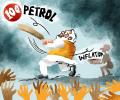
'People know if inflation is not within the tolerance band, then action will be taken so they do not expect inflation to rise above that.'
The indications are all there but it will still be a few days before banks start raising lending rates that affect your equated monthly instalments (EMI).
With concern on food inflation ebbing with the monsoon progressing well, the Reserve Bank of India (RBI) is warming up to the idea of a change in stance to "neutral" from "withdrawal of accommodation", according to economists. In his speech on Thursday during the annual event of the Federation of Indian Chambers of Commerce and Industry-Indian Banks' Association, RBI Governor Shaktikanta Das said: "The balance between inflation and growth is well-poised."

India imports 80 percent of its oil, which adds to inflationary pressure.

The liquidity in the banking system moved into surplus almost after three months as the Reserve Bank of India (RBI) absorbed over Rs 40,000 crore from the market on Monday, predominantly on the back of increased government spending. However, this situation may be short-lived given the higher demand for funds to pay taxes and year-end targets, treasury executives said. Meanwhile, two variable reverse repo rate (VRRR) auctions held on Tuesday received weak response.

Shares of state-owned bank stocks were under pressure on Monday due to muted deposit and credit growth numbers reported by these lenders in the October-December quarter (Q3) of 2024-25 (FY25). The Nifty PSU Bank index was down 4 per cent, with Union Bank of India emerging as the biggest loser as its shares fell 7.5 per cent to close at Rs 114.7, followed by a 5.7 per cent drop in shares of Bank of Baroda (BoB) to Rs 228 and a 4.7 per cent slide in shares of Bank of India to Rs 99.8 on the National Stock Exchange.
Housing loan, car loans, personal loans and education loan will get costlier in the months to come.
Cutting the rates and the ratio by about a 100 basis points will send the right signal as well as give the RBI credible room to make further reductions in the coming months as the situation warrants.

After months of denying there was a liquidity problem, Governor Raghuram Rajan has reversed course.

RBI has held its short-term lending (repo) rates unchanged at eight per cent since April 2012.

To minimise risk, invest in a debt fund whose duration matches your investment timeframe.
Home, consumer, corporate and personal loans are likely to become cheaper with the Reserve Bank cutting its key short-term repo rate by 1 per cent to 8 per cent, the first since 2004, bankers said. After slashing the cash reserve ratio by 2.5 per cent from 9 to 6.5 per cent with effect from October 11, the Reserve Bank cut the repo rate on Monday, which is the rate at which banks borrow from the apex bank.

Retail inflation dipped marginally to a nearly six-year low of 3.34 per cent in March due to a decline in prices of vegetables and protein-rich items. The Consumer Price Index (CPI) based inflation was 3.61 per cent in February and 4.85 per cent in March last year.
Challenged by unrelenting inflationary pressures, Reserve Bank on Tuesday announced stringent measures of hiking mandatory cash reserve of the banks and its short-term lending rate to them to suck up an estimated Rs 20,000 crore (Rs 200 billion) -- a move that could make loans dearer for housing, car and personal expenses as also to the industry.

The RBI kept its key policy repo rate unchanged at 8.0 percent in its recent monetary policy.

Select the exact category by matching your investment horizon to the portfolio duration, suggests Sanjay Kumar Singh.
Finance Minister P Chidambaram on Monday said he does not expect the Reserve Bank of India to hike interest rates in the July review of the monetary policy

Soft crude prices will cut fuel subsidy bill and help contain fiscal slippage this year.
The government has taken on more and more debt to finance the deficit and more debt also means more interest.
Expecting the Reserve Bank of India to maintain stable and soft interest rates in credit policy, State Bank of India on Wednesday hinted at further cut in home and consumer loan rates.

The bank also announced that it will reduce its external benchmark linked lending rate as well as repo linked lending rate by 40 basis points from July 1.

HDFC Bank, the country's second-largest private sector bank, has cut its base rate by 15 basis points (bps) to 9.70 per cent.

Shares of rate-sensitive realty, bank and auto sectors were on buyer's radar on Wednesday.

The banking sector in India is reeling under Rs 8 lakh crore of non performing assets (NPAs) or bad loans, of which PSU banks alone account for over Rs 6 lakh crore.
